Features
Everything a part needs
A sketcher with a real solver, a feature history you can edit at any step, and a kernel of its own on exact surfaces.
Sketcher
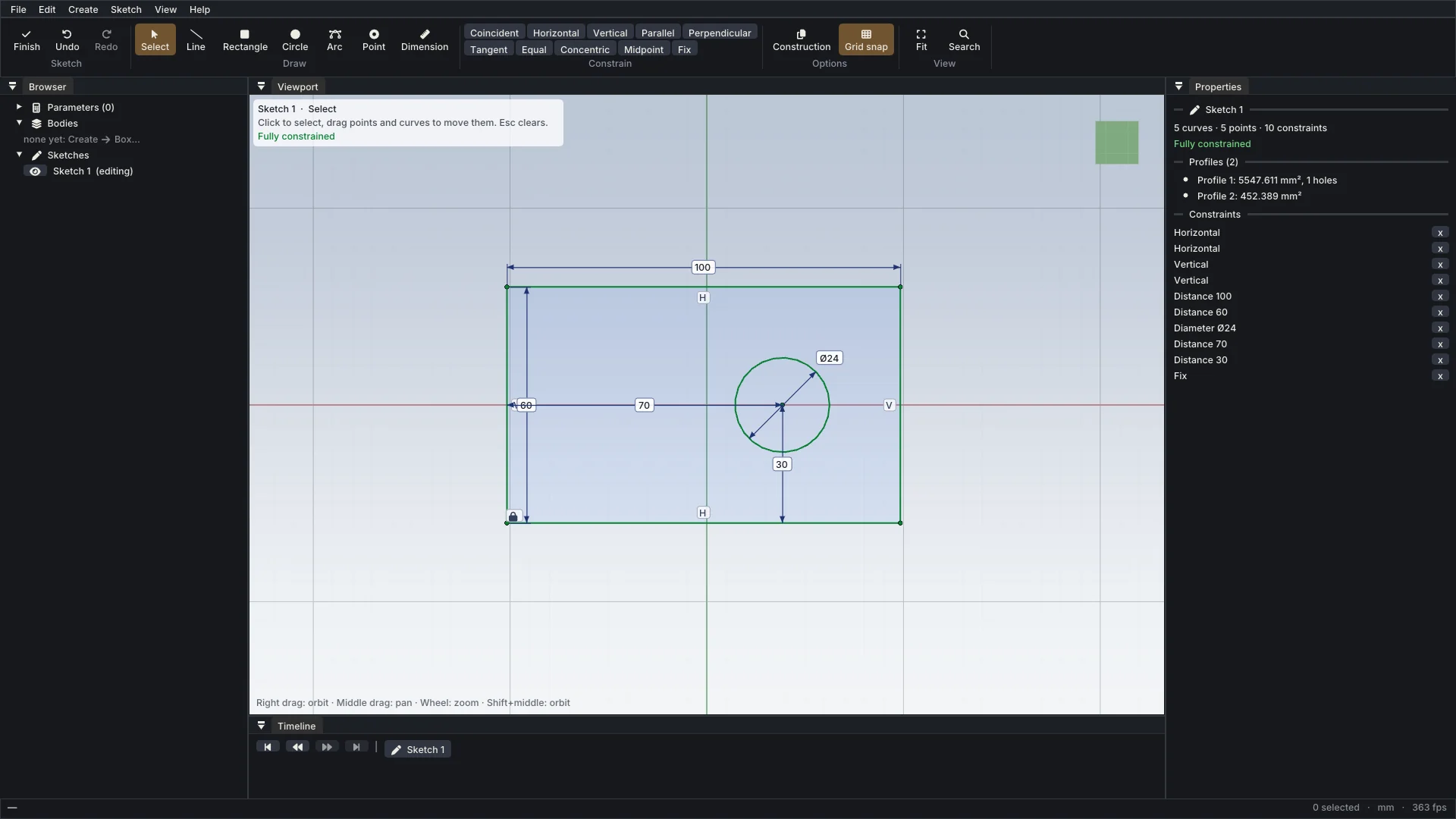
Points, lines, rectangles, circles, arcs, Bézier splines and construction geometry.
- Constraints: coincident, horizontal, vertical, parallel, perpendicular, tangent, equal, concentric, midpoint and fix.
- Dimensions: distance, angle, radius and diameter, each of which can be an expression (20mm + w/2, 1in, 45deg).
- A Levenberg–Marquardt solver counts the degrees of freedom and refuses constraints that are redundant or conflicting.
- Profiles, holes included, are found automatically.
- An offset tool copies a chain of curves to one side, mitring its corners, and the copy follows the curves and its distance.
Features and history
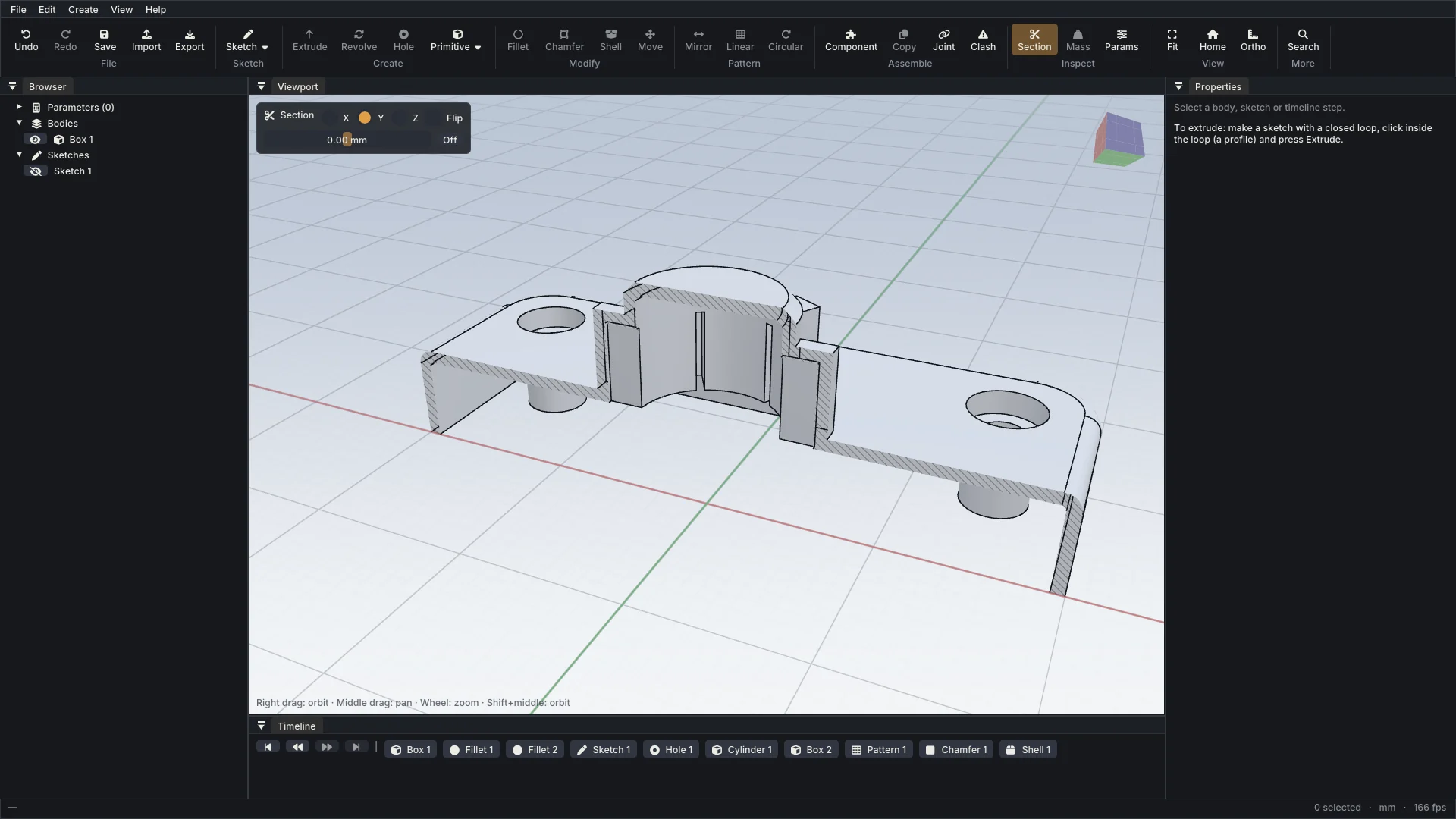
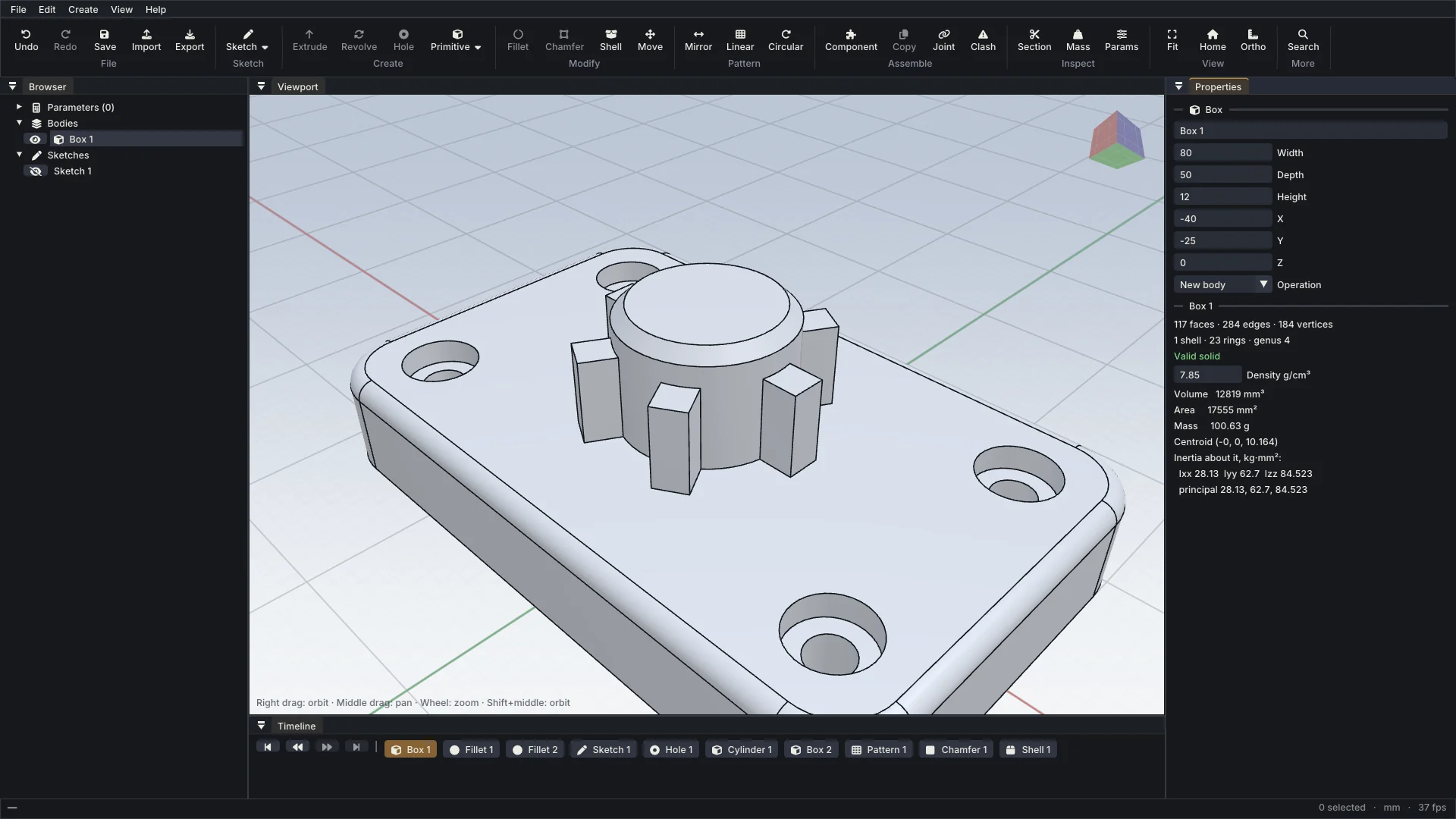
Extrude and revolve, primitives, holes (simple, counterbored, countersunk), fillet and chamfer, shell, mirror, linear and circular patterns, and moving bodies with a gizmo.
- Every feature can make a new body, or join, cut or intersect with the bodies it touches.
- A parameters table drives the dimensions.
- The timeline has a rollback marker, regeneration is incremental, and undo and redo work for every step.
- Faces are named by the feature that made them, so a sketch on a face or a fillet on an edge still finds its target after an edit upstream.
Its own geometry kernel
A pure-Go B-rep on exact analytic surfaces: planes, cylinders, cones, spheres and tori. No OpenCASCADE, no other CAD library.
- Intersection curves are traced, then made exact where the surfaces meet in a line, circle or ellipse.
- Each face is split in its own parameter space and classified by winding number.
- Faces on the same plane are merged afterwards.
- Fuzz tests check the booleans against volume identities.
Assemblies
Components from other .forma files, put together with joints.
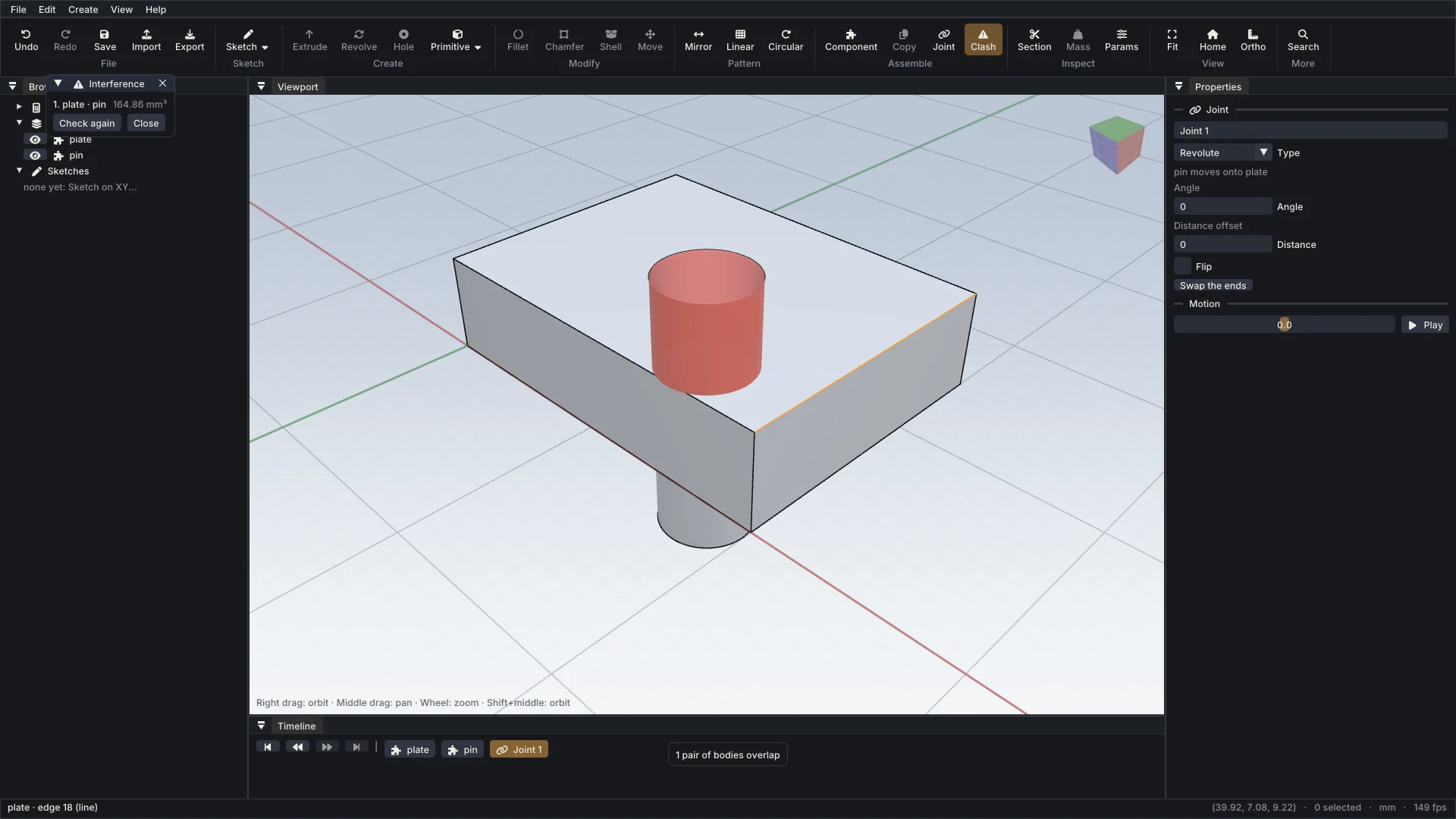
- Rigid, revolute, slider and cylindrical joints with motion and limits; grounding.
- Interference checks.
- A bill of materials (CSV) and an exploded view.
Stress analysis
How a part bends under load, and where it is weakest.
- The part meshed with 10-node tetrahedra.
- Faces held fixed or loaded by a force or a pressure; a material from a list.
- Von Mises stress or displacement painted on the deformed part, with the maximum stress and the safety factor.
- Checked against beam theory and a plate with a hole.
Electronics
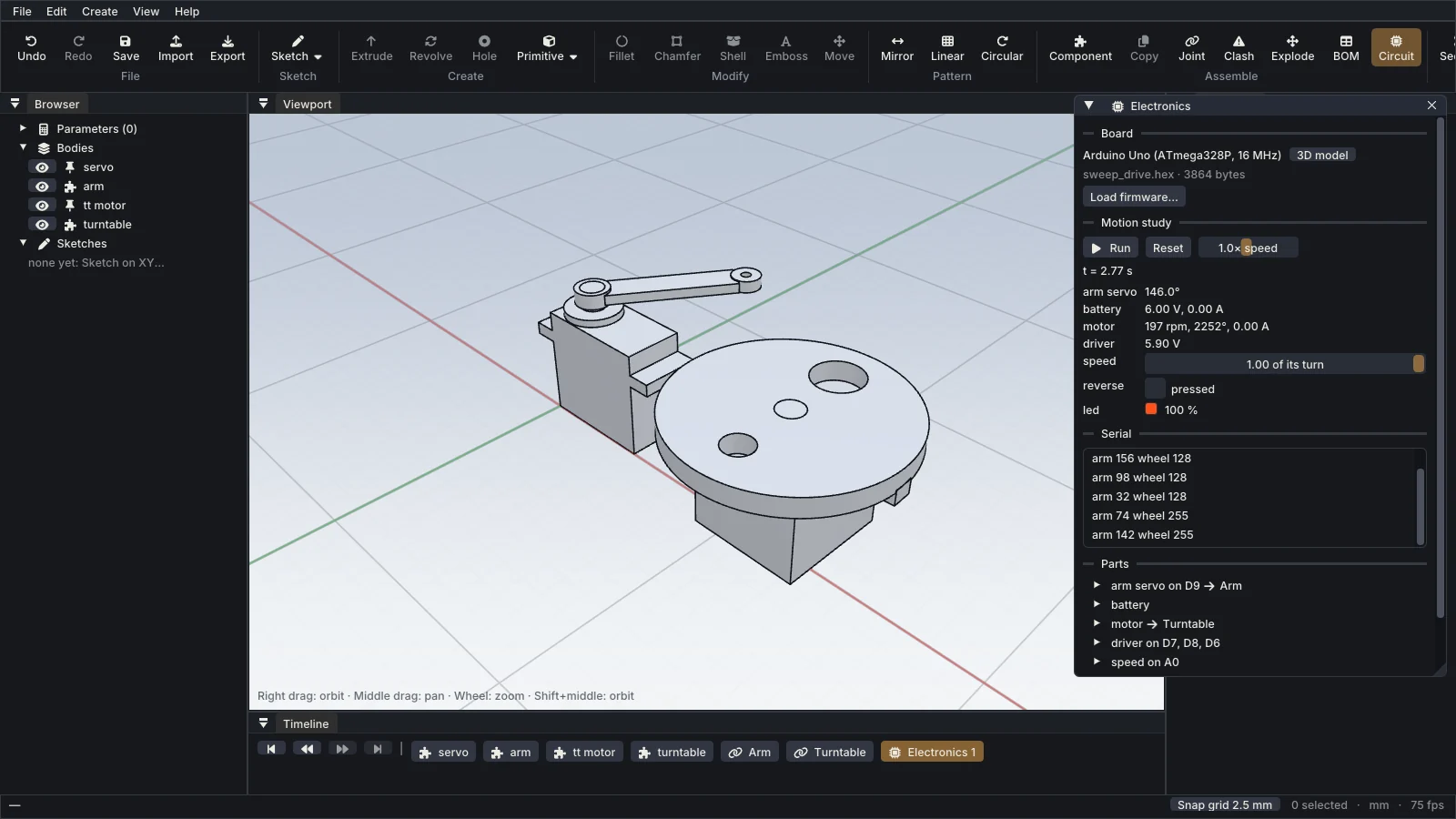
A real Arduino sketch moving the assembly's joints.
- An Arduino Uno emulated in Go: the ATmega328P with its timers, serial port and ADC runs a compiled sketch (a .hex, or an .ino built with arduino-cli).
- Servos, gear motors, motor drivers, batteries, pots, buttons and LEDs from a small library, wired to its pins.
- A motion study: run it, turn a pot, press a button, read the serial monitor, and watch the shafts drive the joints.
- The parts also come as 3D models (Uno, SG90, TT motor, AA holder, driver boards) to design round.
Drawings
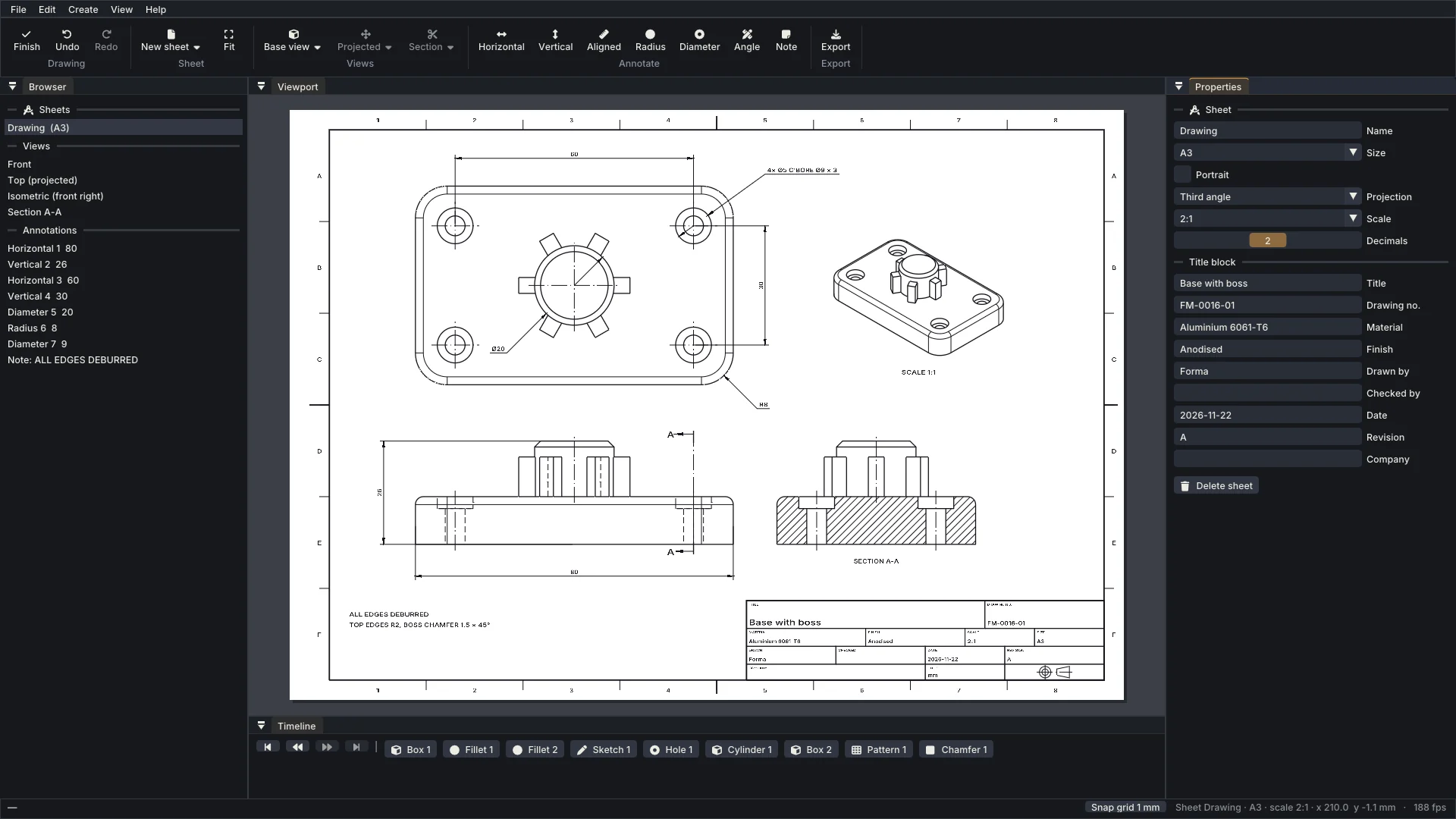
Sheets from A4 to A0 (or ANSI A–E) with a title block, in third or first angle projection.
- Front, top, side and isometric views, laid out and scaled to the sheet.
- Hidden lines, silhouettes of curved faces, and centre lines on holes and bosses.
- Projected views and sections (cut by the kernel and hatched) that stay lined up with the view they come from.
- Horizontal, vertical, aligned, radius, diameter and angle dimensions, tied to the edges they measure, so they follow an edit. Notes.
- Exported as PDF, SVG or DXF R12. The sheets are saved in the design.
Inspect and exchange
Measuring, mass properties and section views; files in and out.
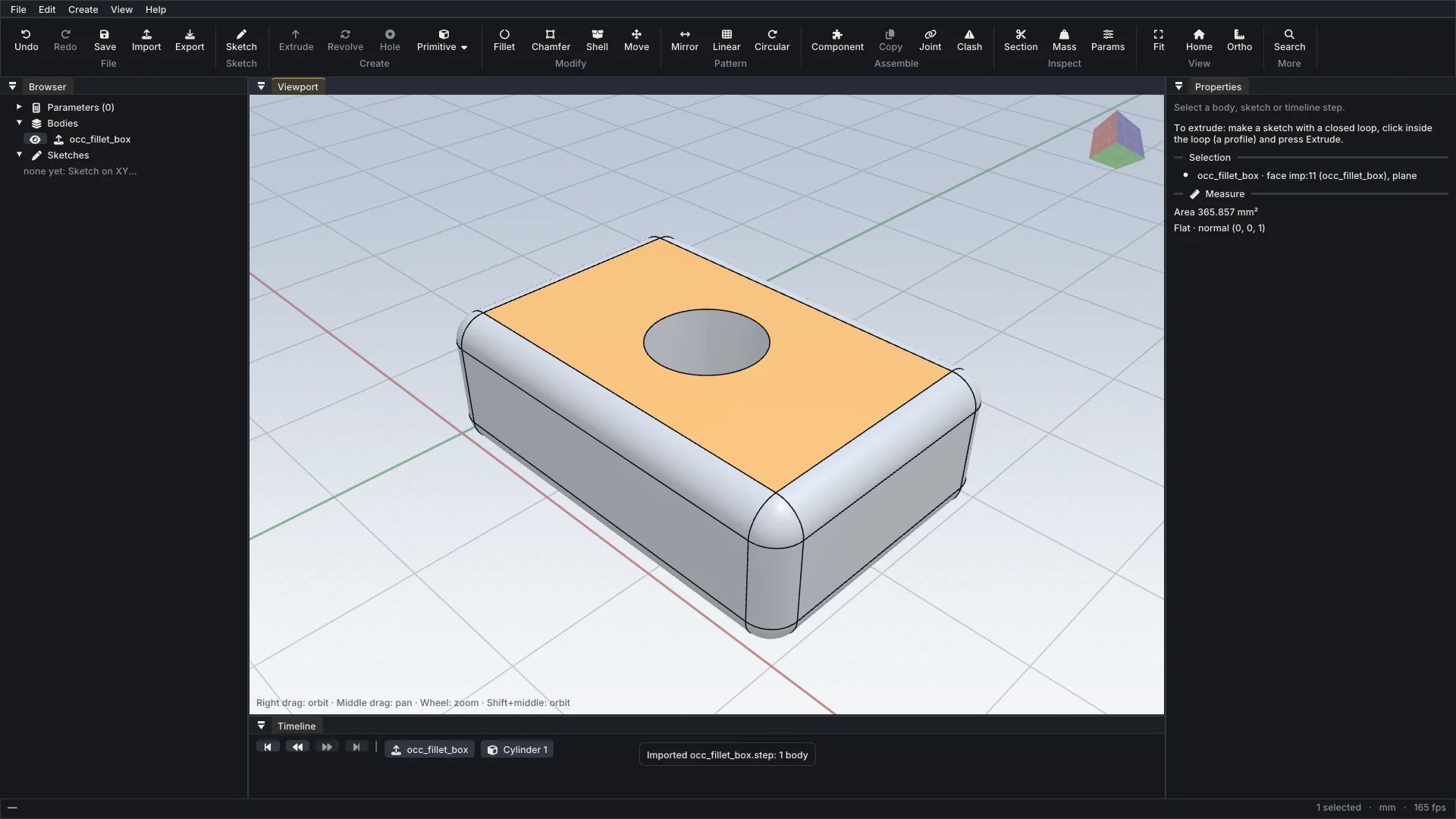
- STEP AP214: export of solids and assemblies, and import of AP203/AP214/AP242 solids on analytic surfaces.
- STL in (as a reference mesh) and out; OBJ out.
- STEP output is checked against OpenCASCADE in the tests.
The app
A docked Dear ImGui layout drawn with OpenGL 4.1.
- A ribbon toolbar and a Ctrl+K command palette.
- Native file dialogs and autosave.
- Exact picking from an ID buffer.
- Arrows to resize features, a Resize · Move · Turn · Scale bar, and snapping to a set increment (Ctrl for free movement, Shift for fine control).
Gallery
What doesn't work yet
Forma is young. Fillets work on some edges only, three rounds meeting at a corner mitre instead of blending, and long histories regenerate slowly. Every known gap is listed, with an ID, in docs/LIMITATIONS.md.